
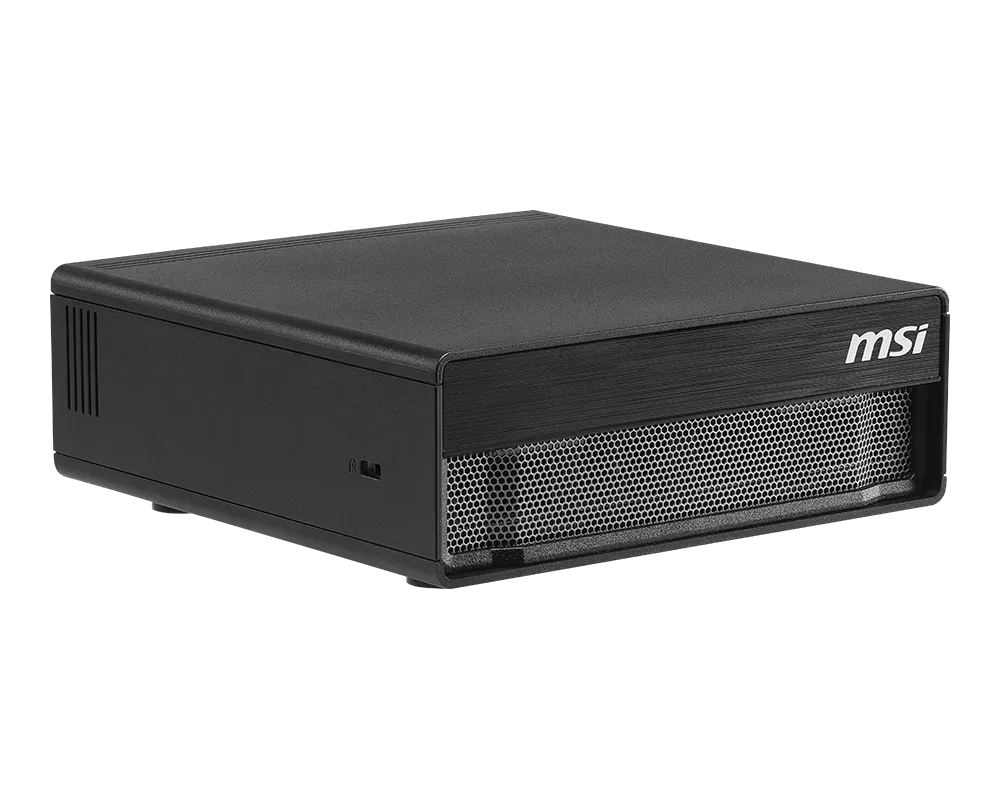




The 5 Surprising Secrets of This AI Supercomputer: Why MSI EdgeXpert Outperforms Reference Design
The MSI EdgeXpert is a desktop AI supercomputer built on the NVIDIA GB10 / Grace Blackwell architecture. While it shares the same foundation as NVIDIA's reference design, MSI’s engineering team has re-imagined the hardware. Through advanced thermal and system engineering, they have achieved approximately 10% higher performance than the NVIDIA original.
More than just hardware, this device represents a strategic entry point into the complete NVIDIA CUDA and AI software ecosystem. Here are the five surprising truths behind this compact "black box".
The "Modded" Version is Faster: Thermal Engineering is the True Differentiator
Why is the MSI EdgeXpert 10% faster than the NVIDIA reference design despite using the exact same architecture? The answer lies not in the silicon, but in thermal and power management.
Benchmark Performance:
In GPT OSS 120B testing, the MSI EdgeXpert achieved 1729.52 tokens/s, compared to roughly 1600 tokens/s on the NVIDIA reference design—a 10% out-of-the-box performance boost.The Engineering Secret:
The core driver of this performance is a superior thermal solution featuring a Vapor Chamber design, which allows the system to stably sustain power consumption over 200W without thermal throttling.Significantly Lower Temperatures:
Under stress, the MSI unit runs much cooler than the reference design:- Rear chassis: 15°C lower.
- Top surface: 9.1°C lower.
- SSD: 9°C lower.
As noted in reviews, "MSI has done a great job engineering this... that's why this is faster 10% out of the box". However, top-tier performance comes at a cost: the MSI unit draws approximately 12% more power, proving that in high-end hardware, superior engineering converts power directly into sustained performance.
The Counter-Intuitive Truth: It’s Not Always Faster
Surprisingly, for standard AI inference tasks, this expensive NVIDIA GB10 platform performs similarly to AMD’s "scrappy little platform," the Strix Halo, which is significantly cheaper.
However, the NVIDIA platform justifies its premium in specific, complex scenarios where it creates a massive performance gap:
Long Context / Long Prompts.
Compute-Intensive Tasks:
Such as Stable Diffusion.Quantization:
Offering superior speed and accuracy compared to other 4-bit formats.
The AMD Limitation: While cost-effective, AMD’s ROCm ecosystem is primarily optimized for the data-center-focused CDNA architecture. It is not fully aligned with the RDNA architecture used in the Strix Halo, leading to a fragmented toolchain and a less stable development experience.
The Real Superpower: Access to the NVIDIA Software Ecosystem
Buying an EdgeXpert is effectively buying a ticket to the unified NVIDIA software ecosystem. This includes CUDA, TensorRT-LLM, NVIDIA NIM, and NCCL distributed computing.
"Cloud Experience on Your Desk":
It allows developers to develop, fine-tune, and validate models locally, then seamlessly scale the entire workflow to massive cloud or data center DGX systems.Seamless Scaling:
As noted in reviews, scaling on these GB10 units is "basically the same as like the big GB200/GB300 setups".Enterprise Connectivity:
Features like the built-in ConnectX-7 high-speed network interface and native NCCL support highlight that its true value lies in distributed computing capabilities, not just standalone performance.
Why Test an AI Machine with Triple-A Games?
The EdgeXpert can run massive x86 PC games like Cyberpunk 2077 and Doom Eternal on its ARM architecture via Box64, delivering performance comparable to a 5070-class GPU.
While reviews explicitly state "don't buy this for gaming on ARM," this serves as a brilliant "Real-World Stress Test".
- Running these games places extreme, simultaneous loads on CPU translation, GPU graphics rendering, and memory bandwidth.
- This validates the system's engineering stability under complex, sustained loads—something standard AI benchmarks might miss. It proves that MSI’s thermal solution can handle extreme compound workloads without faltering.
Who is MSI EdgeXpert Actually For?
To be direct: This machine is not for the average AI hobbyist or someone looking for a home AI assistant.
The Ideal Audience:
AI Developers, Researchers, and Startups:
Professionals who need a local "perfect sandbox" that mirrors the architecture of large-scale NVIDIA ecosystems (like Grace Blackwell).Teams Optimizing Costs:
It allows teams to validate models and workflows locally before renting expensive cloud computing time, minimizing deployment risks.
The Strategic Value: As the review succinctly puts it: "...everybody that is focused on inferencing performance is missing the boat... this is your toe in the water to give you the CUDA ecosystem plus all of the other stuff". The value isn't just raw speed; it's about preparing your projects for the future of AI infrastructure.
Conclusion: Wisdom Beyond the Spec Sheet
The MSI EdgeXpert is more than a hardware victory; it is the physical embodiment of NVIDIA’s market strategy—locking developers into their ecosystem right from the desktop.
For professionals, the choice is strategic: Do you want a platform that gives the highest inference score for today's tasks (like AMD), or do you invest in a validated (albeit expensive) ecosystem that paves the road to the AI factories of tomorrow?