
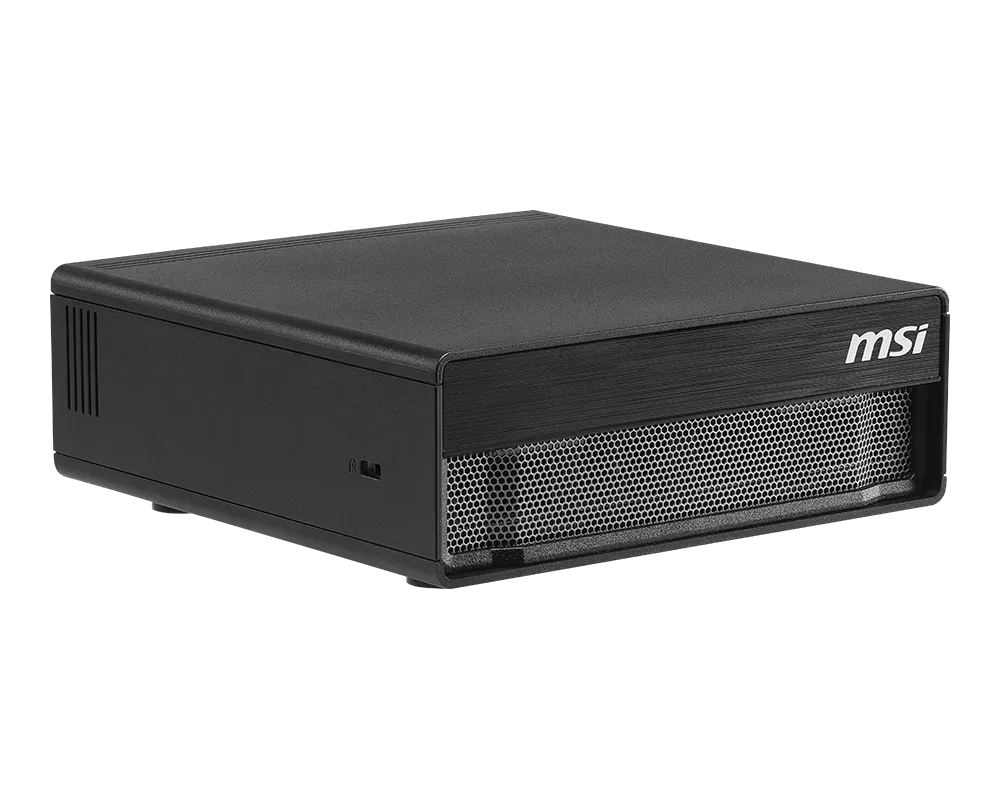




Unlocking Potential: Why is MSI EdgeXpert's AI Performance Faster, Despite Using the Same Grace Blackwell Architecture?
MSI EdgeXpert utilizes the same NVIDIA Grace Blackwell GB10 architecture as the DGX Spark. However, due to the integration of a high-end Vapor Chamber (VC), a three-heat-pipe module, large-area copper fins, and optimized airflow design, it avoids thermal throttling under heavy load. As a result, its measured AI performance is approximately 10% faster. The temperature performance for the chassis, SoC, and SSD is significantly lower than the DGX Spark, allowing the system to sustain high power for longer durations and deliver more stable AI inference and training performance.
Same Architecture, Why Can MSI EdgeXpert Run Faster?
In an era of rapid growth in AI edge computing and data center workloads, hardware cooling and thermal management have become the core factors determining AI inference speed.
Although both MSI EdgeXpert and DGX Spark employ the NVIDIA Grace Blackwell GB10 architecture, many users assessing these systems often wonder:
Why is there a performance gap of approximately 10% despite the identical architecture?
The answer lies in MSI's deep commitment to thermal engineering, material selection, and airflow design. The following sections will provide a complete explanation of how MSI EdgeXpert delivers higher performance within the same architecture, based on three aspects: hardware structure, airflow design, and measured data.
I. Advanced Thermal Technology: How Does EdgeXpert Maintain Low Temperatures Under Heavy Load?
The key technologies of the high-end VC and heat conduction system enable MSI EdgeXpert's core performance advantage to maintain low temperatures under heavy load, thanks to professional internal cooling components:
High-Efficiency Vapor Chamber (VC) + Triple Heat Pipe Module
MSI EdgeXpert adopts a VC with high thermal conductivity. Compared to traditional heat pipes, the VC can dissipate heat more rapidly and evenly.
This is paired with three heat pipes and a copper-fin heatsink, effectively accelerating the expulsion of heat from the GPU and SoC, reducing thermal accumulation.Large-Area Copper Fin Structure
The densely stacked copper fins significantly increase the heat exchange area, enhancing convection efficiency and allowing for more efficient cold/hot air exchange to design a more effective thermal structure.Surface Temperature Management Design
The chassis uses a plastic-over-metal structure, which significantly lowers the external shell temperature, maintaining a comfortable contact surface (below 51°C) even during prolonged operation.
Stronger cooling module → More stable GPU clock speeds → Faster AI inference speed.
II. Mechanical Design Optimization: Maximizing Airflow Efficiency
During prolonged AI inference and training, performance is often limited not by architecture, but by temperature.
Therefore, besides high-performance copper fins and the VC, the overall airflow design strategy is the crucial factor affecting AI performance stability.
MSI EdgeXpert's mechanical layout is built upon this logic:
Maximized Intake Volume on the Front Panel
The front air inlets are enlarged to allow cold air to be directly channeled into the GPU and core cooling zones.Airflow-Guiding Rear Panel + Side Vents
The airflow-guiding structure prevents hot air from recirculating, making the airflow path cleaner and avoiding thermal loops.Raised Bottom Feet + Grille Openings
The design uses tall feet to increase space at the bottom, allowing key components like the SSD and VRM to dissipate heat faster.
By maximizing air intake, optimizing the hot air exhaust path, and reducing heat recirculation, MSI EdgeXpert ensures cold air flows quickly into the core component areas, and hot air is expelled more effectively. This structural design not only improves cooling efficiency but also allows the GPU, SoC, and SSD to operate at more stable power for extended periods, thereby boosting AI inference and training performance.
Smoother airflow → System maintains higher power output → Overall AI performance is more stable.
III. Temperature Comparison Data: How Does MSI EdgeXpert Outperform DGX Spark?
During the GPU stress test (Nvidia_n1x_power_stress_external-8.0), MSI EdgeXpert's temperatures at multiple key points were significantly lower than the DGX Spark FE:
Temperature Test Point
MSI EdgeXpert Temperature
NVIDIA DGX Spark Temperature
Temperature Difference (ΔT)
Chassis (Rear Panel)
48.6 °C
63.6 °C
-15 °C
Chassis (Top)
41.8 °C
50.9 °C
-9.1 °C
SoC (GPU Stress Test)
85 °C
86 °C
-1 °C
SSD (Stress Test)
52 °C
61 °C
-9 °C
Multiple tests demonstrate that MSI EdgeXpert's structural cooling and system tuning are superior to the NVIDIA DGX Spark overall.
MSI EdgeXpert: Trading Lower Temperatures for Faster, More Stable AI Performance
Through a more robust cooling and airflow design, MSI EdgeXpert successfully overcomes the thermal limitations of the DGX Spark FE, achieving overall improvements in AI performance and stability.
AI Performance Boost: Approximately 10% Faster
In the GPT OSS 120B test, MSI EdgeXpert could maintain a higher steady-state power, resulting in inference speeds approximately 10% faster than the FE.Sustained Full Load Without Throttling
The EdgeXpert can maintain a sustained power of over 200W for prolonged periods without downclocking.
The FE enters throttling sooner due to faster temperature accumulation.Lower SSD Temperature for More Stable I/O
MSI uses a pure copper-nickel plated thermal plate, keeping the SSD below 59°C, preventing thermal throttling and improving overall AI pipeline efficiency.Conclusion: Cooling = AI Performance
By leveraging superior VC and air-guiding design, MSI EdgeXpert overcomes the Spark FE's cooling bottleneck, providing faster, more stable, and more reliable hardware performance during high-load, long-duration AI computing.
Applicable Scenarios: Which AI Workloads Benefit the Most?
MSI EdgeXpert is particularly suitable for applications that require stable, long-term, and non-throttled performance output:
- 24/7 AI Inference Servers
- Large Model Training / Fine-tuning (LLM, Vision, Multimodal)
- Data Scientists' Long-duration Computing Environments
- Edge AI Deployments
- High-Density Server Rooms, AI Clusters
- Developer Workstations requiring stable cooling
The common characteristic of these applications is the need for consistent, sustained performance, which is precisely what the MSI EdgeXpert is built for.
Thermal engineering is the core key that allows MSI EdgeXpert to surpass DGX Spark. MSI EdgeXpert's leadership comes not from architectural differences, but from MSI's long-term commitment to thermal engineering, including: the VC, high-efficiency heat pipes and copper fins, and optimized mechanical airflow design. These designs enable the system to deliver cooler, more stable, and faster AI performance within the same architecture, making MSI EdgeXpert the preferred Grace Blackwell platform for an increasing number of AI developers, research institutions, and data centers.